
How to Stop Yelling at Your Kids and Repair When You Do
I remember sitting down on my prayer mat after Isha and running through my day.
When I got to the part where I'd screamed at my children to go to bed, my throat went tight. The guilt washed over me all over again. I had promised myself I wouldn't yell anymore, and here I was, breaking that promise already.
If you've ever sat in that same spot, Sis, replaying "Go to bed, NOW!" in your own voice, this post is for you.
Learning how to stop yelling at your kids isn't about becoming a different woman overnight. It's about having a plan for the moment before, the moment during and the moment after.
Honestly? Even with all my Positive Discipline training, the right words would fly straight out of my head in the moment. Knowledge wasn't my missing piece. A plan I could follow with nothing left in the tank was.
Why "just be patient" isn't a plan
When I surveyed over 300 Jannah mums, "patience" was the word they used most to describe what they feel they're missing.
One mother in my survey wrote simply: "Shouting when I'm overwhelmed". Another wrote: "Nagging, screaming on top my voice...I just wanna run sometimes may Allah make it easy for us".
Aameen to that dua. What both mothers describe isn't a lack of love or iman. It's overwhelm, at the exact hour your children need the most from you.
You can't top up patience on demand at 7pm. But you can set things up so your calm stops depending on it. Here's how, in five steps.
Step 1: Start strong by catching the rise
Yelling rarely comes from nowhere. It usually arrives after the third "I said, shoes on" or the fifth "Come and eat", with your voice climbing a little each time.
So the first step is noticing the climb before it peaks. Learn your own early warning signs:
Your jaw tightens or your shoulders creep up.
You start saying the same sentence louder instead of differently.
You hear yourself say, "How many times do I have to tell you?"
When you notice one, that's your cue to pause, not push. The Prophet ﷺ said: "The strong is not the one who overcomes the people by his strength, but the strong is the one who controls himself while in anger." (Sahih al-Bukhari 6114)
When two men were insulting each other in front of him, he said that if the angry man said, "I seek refuge with Allah from Satan, the outcast," it would calm him (Sahih al-Bukhari 6115).
Do this now: Choose your pause today. Say A'udhu billahi min ash-shaytan ir-rajim, take one slow breath out, and unclench your hands. That's your circuit breaker.
Step 2: Dive in with words you prepared earlier
So often we yell because, in that second, we genuinely don't know what else to say. The fix is to decide the words before the moment arrives.
Pick the one or two moments that end in shouting most often in your home. For many of us it's bedtime, the school run, or homework at the end of a long workday. Write one calm line for each and save it on your phone.
For bedtime, instead of calling from the doorway for the fourth time:
Say: "It's time for bed now. I'm going to walk you to your room, and you can choose which book we read."
If they keep getting up:
Say: "I love you too much to argue about this. Bed is the plan. I'll come back and check on you in five minutes."
For the morning rush:
Say: "Shoes, then car. Do you want to put them on yourself, or shall I help?"
Short, calm and firm. Gentle does not mean permissive, Sis: the boundary still holds. You've just stopped shouting it.
If you'd like a few of these ready to go, my free 10 Calm Scripts give you five for ages 1-6 and five for ages 7-12.
Step 3: Optimise your approach by changing the moment, not just your voice
Some evenings are set up to fail before anyone speaks. This step takes away the fuel.
Move closer instead of louder. Walk over, get down to eye level, and put a gentle hand on a shoulder before you speak.
Use fewer words. "Teeth, then story" lands better than a lecture about why teeth matter.
Name your danger zone. If 6pm to 8pm is when you lose it, plan for it: a simpler dinner, an earlier bath, ten quiet minutes when you walk in from work.
Pick fewer battles in that window. Not every issue needs solving at 7:45pm.
One mother in my survey wrote: "Patience. I get easily worked up and frustrated." Changing the moment means you need far less patience to begin with.
Step 4: Stay focused, because you will slip (and repair is the real skill)
The goal isn't never yelling again. The goal is getting back to calm faster, and putting it right every time.
Repair teaches your child something powerful: mistakes can be put right, by grown-ups too. Use this simple shape:
1. Return. Come back once you're calm, even if it's an hour later.
2. Repair. Own your part in one sentence, without blaming them for it.
3. Reconnect. Keep the boundary, then offer closeness.
Say: "I shouted at you earlier, and that wasn't okay. I was frustrated, but shouting isn't how I want to talk to you. Bedtime is still at eight, and I love you so much."
For a little one:
Say: "Mummy used a big, loud voice. I'm sorry. Can I have a cuddle?"
Notice what the repair doesn't do. It doesn't take back the boundary, and it doesn't give your child the job of making you feel better. You apologise for the tone, not for being the parent.
If it happened at bedtime, you can still go back in tonight. Kneel by the bed, say your repair line, and let them fall asleep knowing you're still their safe place.
One of Allah's Beautiful Names is At-Tawwab, the One who accepts repentance again and again. Every time we turn back to Him, He turns to us in mercy. Repair with our children is a small way of living that same mercy in our homes.
This is exactly where I used to get stuck, so I wrote the words down. The Calm & Cooperation Scripts include a Return, Repair & Reconnect line for every one of the 200 challenges, so the words for tonight are already waiting for you.
Step 5: Finish strong by turning guilt into a plan
Guilt that sits on your chest all night doesn't help anyone. Guilt that turns into a plan does.
Tonight, after Isha, try this instead of replaying the day on a loop:
Name the moment. "Homework, 7pm, the baby crying."
Name what was underneath. Tired, rushed, hungry, worried about work.
Write your line for next time. One sentence is enough.
Close with dua. Hand the rest to Allah.
You might say:
"Ya Haleem, You are the Most Forbearing. Give me some of Your forbearance with my children tomorrow. Forgive me for today, and let them remember my love far more than my loud moments. Aameen."
Another mother in my survey wrote: "I may fail as a mother cos am already tired." Sis, if that's you, please hear this. Being tired isn't failing, and coming back to the plan after a hard evening is what consistency really looks like.
How to stop yelling at your kids: bringing it all together
Catch the rise, prepare your lines, change the moment, repair every time, and turn tonight's guilt into tomorrow's plan.
You won't get every evening right, and none of us do. But small, steady change is real.
Sis Sekinah, a mother from one of Liamanah's earlier courses, wrote: "I was reflecting on Monday and I realised I hadn’t yelled at my children in 24 hours. ... This is day 3 and I know it can only get better. Ameen."
Which moment ends in shouting most often in your home? Tell me on Instagram @liamanah, and I'll share a calm line for it.
Ready for the words for tonight?
If you're done inventing the right words under pressure, the Jannah Moms Calm & Cooperation Scripts were made for you. That's 400+ word-for-word scripts for 200 daily behaviour challenges, each with a "Do this now" action, a Return, Repair & Reconnect line, and a dua with one of Allah's Beautiful Names.
Ages 1-6 Guide: ₦17,000 / $17
Complete Ages 1-12 Collection: ₦30,000 / $30
Instant PDF download, and a 14-day money-back guarantee
Salam Alaykum, Sis. You're not failing. You're learning, and you're not doing it alone.
Zuliat
Zuliat Lawal is a working mum of two, a Certified Positive Discipline Parent Educator and the author of Mommy's Dua Book. She writes for busy Muslim mothers who want to raise children with character, not just obedience. Read her story.
Before you go
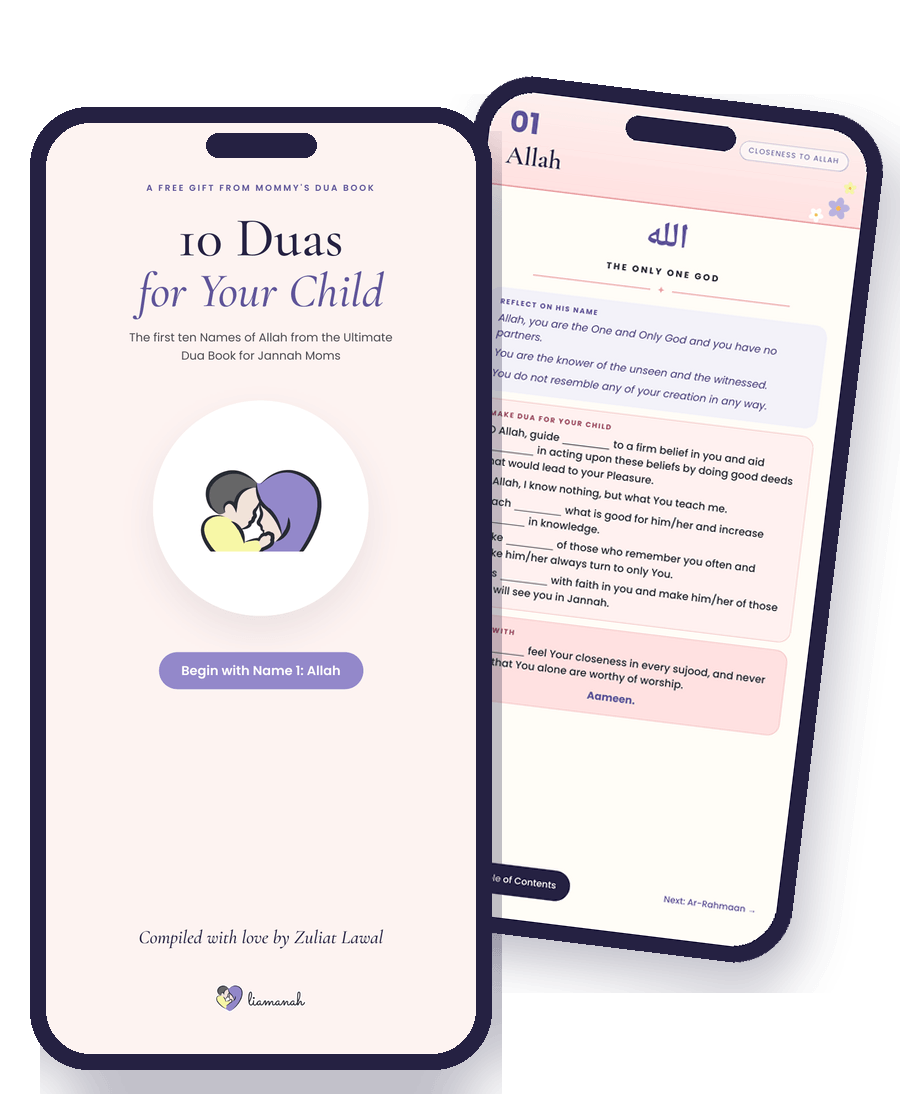
Start with 10 duas for your child, free
The first ten pages of the new Mommy's Dua Book: a heartfelt dua for your child for each of the first ten Beautiful Names of Allah, from Allah to Al-Jabbar, with a space for your child's name in every one.
Reflect on His Name, so your dua begins with praise, the way the etiquette of dua teaches us.
A ready-to-say dua for your child, with a blank for their name, so you never sit on the mat wondering what to ask for.
A closing line for each Name, perfect for a quick dua on the school run.
Free. Your details are safe, and you can unsubscribe any time. See our Privacy Policy.