
How to Get Kids to Listen the First Time Without Threats
7:15am. Picture this. You're at the front door with the car keys in one hand and a lunchbox in the other.
"Shoes on, please." Nothing. "Shoes on." Your child is still lying on the floor, humming.
By the fifth time your voice has an edge, and by the sixth, the whole street can hear it.
If you've been searching for how to get kids to listen the first time without threats, bribes or a shout, you're in the right place. And if a quiet voice in your head is asking, "Isn't this just permissive parenting with nicer words?", this post is especially for you.
In this post, you'll learn
Why repeating yourself isn't a volume problem
Why firm and gentle were never opposites
Why threats and bribes cost more than they save
A simple say-it-once routine, with word-for-word scripts
Myth #1: "If I don't raise my voice, they won't take me seriously"
When I surveyed over 300 Jannah mums, more than 1 in 5 named being ignored, saying it again and again before anyone moves, as their biggest daily frustration. One mother put it perfectly: "Repeating the same thing all over, every time, day is so annoying".
So you are far from alone. But here's the thing about the shout: it does get movement, so it feels like it works. What it quietly teaches is that the first five requests were optional and the shout is the real instruction.
The problem usually isn't volume. It's that the instruction never properly landed. We call it from the kitchen while they're deep in a game, and to a child's brain, that's background noise.
What to do instead is connect before you direct. Walk over and get down to eye level. Say their name, wait for their eyes, and then speak.
Say: "Look at me for a second. Shoes on now, please. I'll wait right here."
That's not softer. It's clearer. And clear is what children respond to.
Myth #2: "Positive discipline is just permissive parenting"
This is the big one, and I want to take it seriously, because the worry is real.
One mother in my survey wrote: "My biggest fear is that my respectful parenting style will backfire and produce entitled , disrespectful children." Another named what she feels she's missing: "How to balance between decipline with mother's love."
Sis, you don't have to choose between the two. Here's the difference in plain words:
Harsh parenting holds the boundary but breaks the connection.
Permissive parenting keeps the connection but drops the boundary.
Positive Discipline is kind and firm at the same time. The boundary stays, and so does the relationship.
In practice, firm-and-kind means you decide what happens, and your child gets a say in how:
Say: "Homework happens before screens. You can do it at the table or at the kitchen counter. You choose where."
When they push back, the answer doesn't change. Only your tone stays warm:
Say: "I hear that you don't want to. It's still homework time. I'll sit with you for the first question."
That's authority without fear. When the answer is no, it stays no, even through the tears. This is exactly how I wrote the Calm & Cooperation Scripts: every script holds the boundary and the connection, so it's firm, never harsh.
Does it work in real homes? A mother from one of Liamanah's earlier courses, Umm Aasiyah, wrote: "I have learned to be more relaxed about children pushing the buttons (because they are children) and I am trying to response instead of react. It is still a way to go but alHamdulillaah step by step."
Step by step. That's what Tarbiyah is: not training instant compliance, but growing character, one ordinary morning at a time.
Myth #3: "Threats and bribes are the only things that work fast"
Threats feel powerful in the moment: "If those shoes aren't on, there's no tablet for a week!" Then the week comes, and you either enforce something you didn't mean or quietly let it go.
Either way, your child learns your words don't quite mean what they say.
Bribes have a different cost. "If you get in the car, you can have sweets" teaches children that cooperation is something you pay for. And the price goes up.
One mother in my survey described the gap many of us feel when we put down the harsher tools: "Discipline since have decided not to spank them". If you've made that decision too, alhamdulillah. The question is what goes in its place, and the answer is calm follow-through.
The Prophet ﷺ said to 'A'isha: "verily Allah is kind and He loves kindness and confers upon kindness which he does not confer upon severity" (Sahih Muslim 2593). Kindness isn't the weak option. It's the one Allah puts barakah in.
So instead of threats and bribes, try these two tools:
1. When-then. It's not a bribe. It's simply the order of the day.
Say: "When your toys are in the box, then we'll head to the park."
2. Kind action instead of more words. If the instruction has landed once and nothing happens, don't repeat. Move.
Say: "I can see it's hard to stop playing. I'm going to help you with your shoes now."
Then calmly hand them the shoe, or gently guide them to the door. No lecture, no raised voice. Your actions back up your words, and your words start to mean something again.
Lessons from the myths: how to get kids to listen the first time
Every one of these myths points to the same truth. Children don't need a louder mother. They need a clearer, steadier one. Here's the routine to practise this week:
1. Connect first. Go to them, get to eye level, say their name, and wait for eye contact.
2. Say it once, in ten words or fewer. "Bath time. Toys in the box, please."
3. Check it landed. For older children: "What did I just ask?" For little ones: "What's first?"
4. Offer a choice inside the boundary. "Blue towel or green towel?"
5. Follow through with kind action. No repeating, no threatening. Just help.
6. Notice the win. "You came the first time. Thank you, that made our evening easier."
That last step matters more than it looks. Children grow towards what we notice, and specific encouragement builds the habit of listening far better than criticism does.
Before you give that first instruction of the evening, try the dua of Musa (alayhi as-salam): "My Lord, expand [i.e., relax] for me my breast [with assurance] And ease for me my task And untie the knot from my tongue That they may understand my speech." (Surah Ta-Ha, 20:25-28)
Rabbi-shrah li sadri, wa yassir li amri, wahlul 'uqdatan min lisani, yafqahu qawli.
It's a dua to be understood, and that's all any of us want at the front door at 7:15am.
Do this now: Choose the one instruction you repeat most (shoes, teeth, coming to eat). Tomorrow, use the say-it-once routine for that instruction only. Notice what changes.
And if you do raise your voice? Repair, and keep the boundary:
Say: "I raised my voice, and I'm sorry. Shoes still go on before we leave. Let's do it together."
If you want to try a handful of these first, my free 10 Calm Scripts are a gentle place to start.
Which instruction do you repeat the most in your home? Tell me on Instagram @liamanah.
Want firm, never harsh words for every daily battle?
The Jannah Moms Calm & Cooperation Scripts give you 400+ word-for-word scripts for 200 daily behaviour challenges, matched to your child's age. Every script holds the boundary and the connection, so you never have to choose between being respected and being kind.
Ages 1-6 Guide: ₦17,000 / $17
Complete Ages 1-12 Collection: ₦30,000 / $30
Instant PDF download, with a 14-day money-back guarantee
Salam Alaykum, Sis. Gentle was never weak. You've got this.
Zuliat
Zuliat Lawal is a working mum of two, a Certified Positive Discipline Parent Educator and the author of Mommy's Dua Book. She writes for busy Muslim mothers who want to raise children with character, not just obedience. Read her story.
Before you go
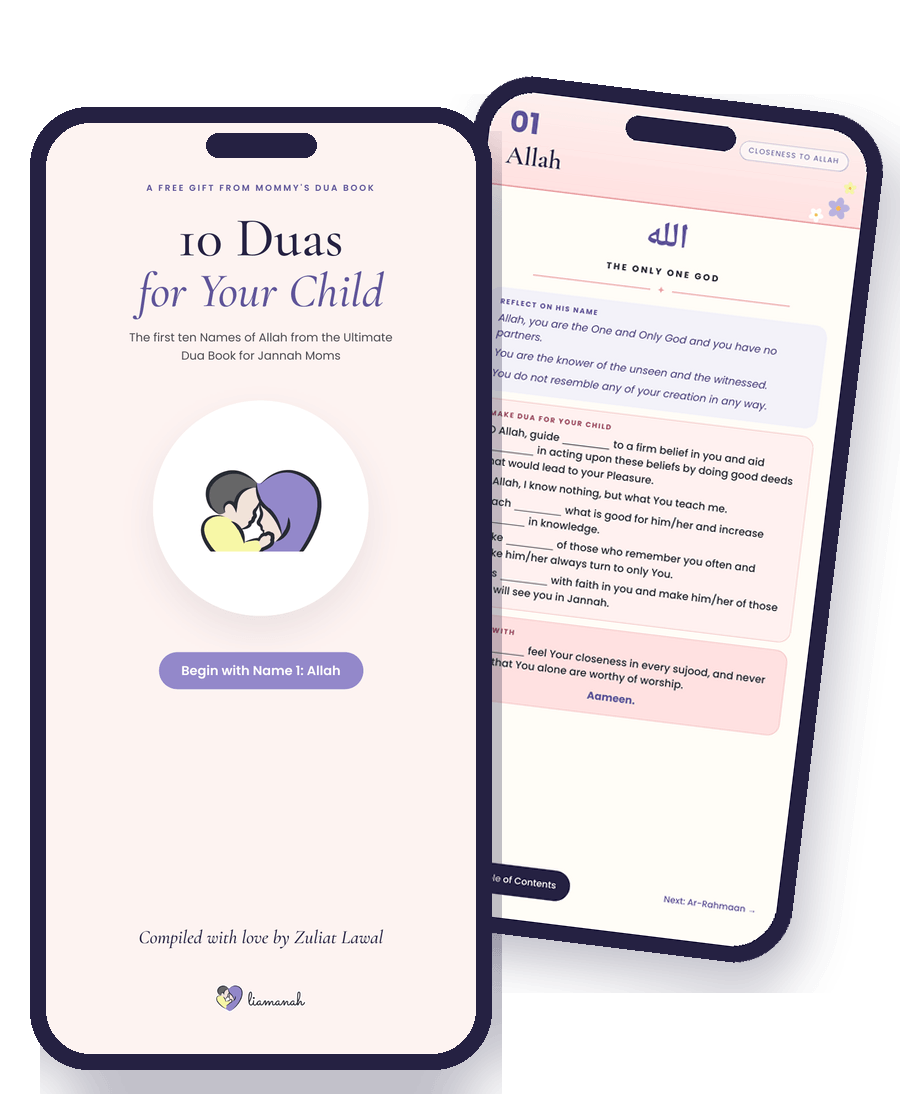
Start with 10 duas for your child, free
The first ten pages of the new Mommy's Dua Book: a heartfelt dua for your child for each of the first ten Beautiful Names of Allah, from Allah to Al-Jabbar, with a space for your child's name in every one.
Reflect on His Name, so your dua begins with praise, the way the etiquette of dua teaches us.
A ready-to-say dua for your child, with a blank for their name, so you never sit on the mat wondering what to ask for.
A closing line for each Name, perfect for a quick dua on the school run.
Free. Your details are safe, and you can unsubscribe any time. See our Privacy Policy.