
When Your Child Does Not Want to Pray
Picture this. The adhan for Asr has just finished.
You call out, "Salah time!" and from the sofa comes a voice you know very well: "I don't want to pray."
You feel it all at once. The frustration, the tiredness, and something deeper underneath it: what if this is the beginning of something? What if my child grows up and walks away from Allah?
If your child doesn't want to pray, Sis, please take a breath first. You're not the only mother standing in that doorway. And the way you answer that sentence matters more than how quickly you get your child onto the mat today.
Why these questions?
When I surveyed over 300 Jannah mums, salah came up again and again, not as a ruling they didn't know, but as a daily struggle they wanted to handle with love.
In this post, you'll discover
Why children say "I don't want to pray" (and what's usually underneath)
What to say in the moment, by age
How to keep Allah from ever becoming a threat in your home
How to repair if you've already shouted about salah
How to build a salah habit that lasts beyond your reminders
A quick note before we begin: this post is about connection and Tarbiyah, not fiqh. For questions about rulings, please ask a qualified scholar you trust.
Question 1: Why does my child say "I don't want to pray"?
Usually, it isn't about Allah at all. It's about the moment. Your child is mid-game, tired, hungry, or has learnt that salah time is also nagging time.
One mother in my survey named her frustration as: "Having to force them to observe solat". Many of us know that feeling. And when salah becomes a daily tug-of-war, a child can start to resist the struggle rather than the prayer.
Underneath the frustration, many of us carry the fear another mother named so honestly: "That I wouldn't fulfill this amaanah from Allah and give it its due right." That fear comes from love. But when fear drives our words, our children feel the pressure, not the love.
So before reacting, get curious. Is it the timing, the tiredness, or does salah feel like something done to them rather than with them?
Question 2: What do I actually say in the moment?
Start with connection, not correction. Go to your child rather than calling from another room, get down to their level, and invite rather than command.
For a younger child (around 3 to 6):
Say: "I'm going to pray now, and I'd love you next to me. Do you want to bring your mat, or shall I put it beside mine?"
If they still say no:
Say: "That's okay. My mat has space for you if you change your mind. I'll save you a spot."
For an older child (around 7 to 12):
Say: "I can see you don't feel like it right now. Salah is still part of our day. Do you want to pray with me now, or finish that level and come in five minutes? I'll wait for you."
Notice the pattern. The boundary stays warm but clear: salah is part of our day. Your child gets a small, real choice inside it: where, with whom, or within a short window.
Allah says: "And enjoin prayer upon your family [and people] and be steadfast therein." (Surah Ta-Ha, 20:132)
There is so much comfort in that second part. The steadfastness is asked of us: patient, consistent reminding, without giving up and without turning harsh.
Do this now: Next salah time, walk over before you speak. Sit beside your child for ten seconds, then give your invitation once, warmly. That's it.
Question 3: How do I make sure my child loves Allah, not just fears getting in trouble with me?
This one matters most, so I'll be plain about it. Never use Allah as a threat. Not when you're tired, not when you're desperate, not even once "to make it work".
A child who prays because they're scared of their mother may stop the moment they leave home. A child who prays because they've been shown Allah's love has a reason that travels with them.
One mother in my survey wrote that her dream was to "Raise kids of jannah who will love islam and not see it as oh mom has started". That says everything. We want salah to feel like coming home, not like "here she goes again".
Some ways to grow that love in the calm moments:
Talk about Allah's Names. Ar-Rahman, the Most Merciful. Al-Wadud, the Most Loving. Let your child hear who Allah is long before they hear about obligations.
Share what salah gives you. "When I pray, I feel calmer. It's my time to talk to Allah about everything."
Let them see your own salah. Children notice what we love, not just what we say.
Keep salah moments short and warm. A cuddle after salam can say more than a lecture.
Question 4: I've already shouted about salah. Have I ruined it?
No, Sis. You haven't ruined anything. One moment doesn't decide your child's relationship with Allah, and how you repair will teach them more than the shout did.
Go back once you're calm. Keep the value, own the tone:
Say: "I shouted at you about salah earlier, and I'm sorry. Salah is precious to me, and I want it to feel precious to you too, not scary. Next time I'll come and sit with you instead of shouting from the kitchen."
Then let it go, and make dua. Allah is At-Tawwab, the One who accepts repentance again and again. If He welcomes us back every time, we can welcome ourselves back to calm too.
If this is the part where you need the words most, the Calm & Cooperation Scripts include more than 20 salah and deen challenges, from "I don't want to pray" to big questions about Allah. Every challenge comes with a dua for the moment, using one of Allah's Beautiful Names, and the source is referenced wherever an ayah or hadith is used.
Question 5: How do I build a salah habit that lasts?
Habits are built in ordinary days, not in battles. A few ideas that fit a busy home:
Anchor salah to something fixed. "When the adhan goes, we stop," or "Maghrib, then dinner." Predictable beats perfect.
Give your child a job. Laying out the mats or reminding the family it's time can turn salah into something they're part of.
Notice effort, not perfection. "You came straight away when I called. That made me so happy."
Make dua for them, out loud and in secret.
The dua of Ibrahim (alayhi as-salam) is perfect for this: "My Lord, make me an establisher of prayer, and [many] from my descendants. Our Lord, and accept my supplication." (Surah Ibrahim, 14:40)
Rabbi-j'alni muqeemas-salati wa min dhurriyyati, Rabbana wa taqabbal du'a.
Notice that he asks for himself first. Our own salah is where our children's salah begins.
Does this gentle approach really work?
No approach comes with a guarantee. But deen grows when it's woven into ordinary moments.
A mother from one of Liamanah's earlier courses, Umm Aasiyah, wrote: "I have been starting to say a longer du`a and the children are repeating after me while we are driving to school. The children are loving it."
Loving it. That's the word we're praying for.
Final thoughts: when your child doesn't want to pray
When your child says "I don't want to pray," it isn't the end of the story. It's an invitation for you to show them who Allah is: the Most Merciful, the Most Loving, the One who always welcomes us back.
Connect before you correct, and invite rather than chase. Repair when you slip, and keep making dua, because guidance comes from Allah alone, and our part is to keep showing up with love.
Got a salah question I haven't answered here? Send it to admin@liamanah.com, and I may answer it in a future post. Or tell me on Instagram @liamanah: which salah is the hardest one in your home?
Want a dua and the right words for every deen moment?
The Jannah Moms Calm & Cooperation Scripts give you calm, deen-rooted words for 200 daily challenges, including 20+ on salah, wudu, Qur'an time and big questions about Allah. A dua for every moment, with each ayah and hadith referenced to its source, so your child is invited into their deen through love, not fear.
Ages 1-6 Guide: ₦17,000 / $17
Complete Ages 1-12 Collection: ₦30,000 / $30
Instant PDF download, with a 14-day money-back guarantee
Salam Alaykum, Sis. May Allah make our children among those who establish the prayer, and make us the reason they love it. Aameen.
Zuliat
Zuliat Lawal is a working mum of two, a Certified Positive Discipline Parent Educator and the author of Mommy's Dua Book. She writes for busy Muslim mothers who want to raise children with character, not just obedience. Read her story.
Before you go
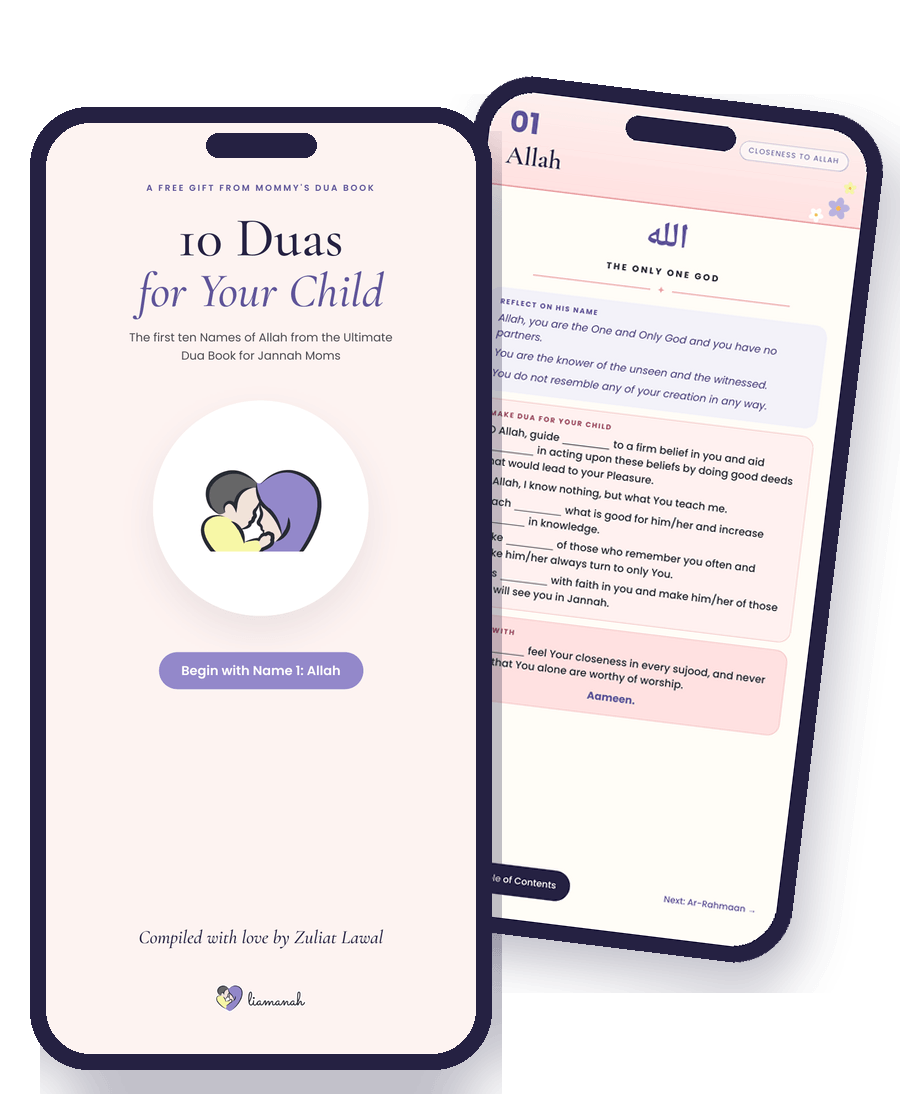
Start with 10 duas for your child, free
The first ten pages of the new Mommy's Dua Book: a heartfelt dua for your child for each of the first ten Beautiful Names of Allah, from Allah to Al-Jabbar, with a space for your child's name in every one.
Reflect on His Name, so your dua begins with praise, the way the etiquette of dua teaches us.
A ready-to-say dua for your child, with a blank for their name, so you never sit on the mat wondering what to ask for.
A closing line for each Name, perfect for a quick dua on the school run.
Free. Your details are safe, and you can unsubscribe any time. See our Privacy Policy.